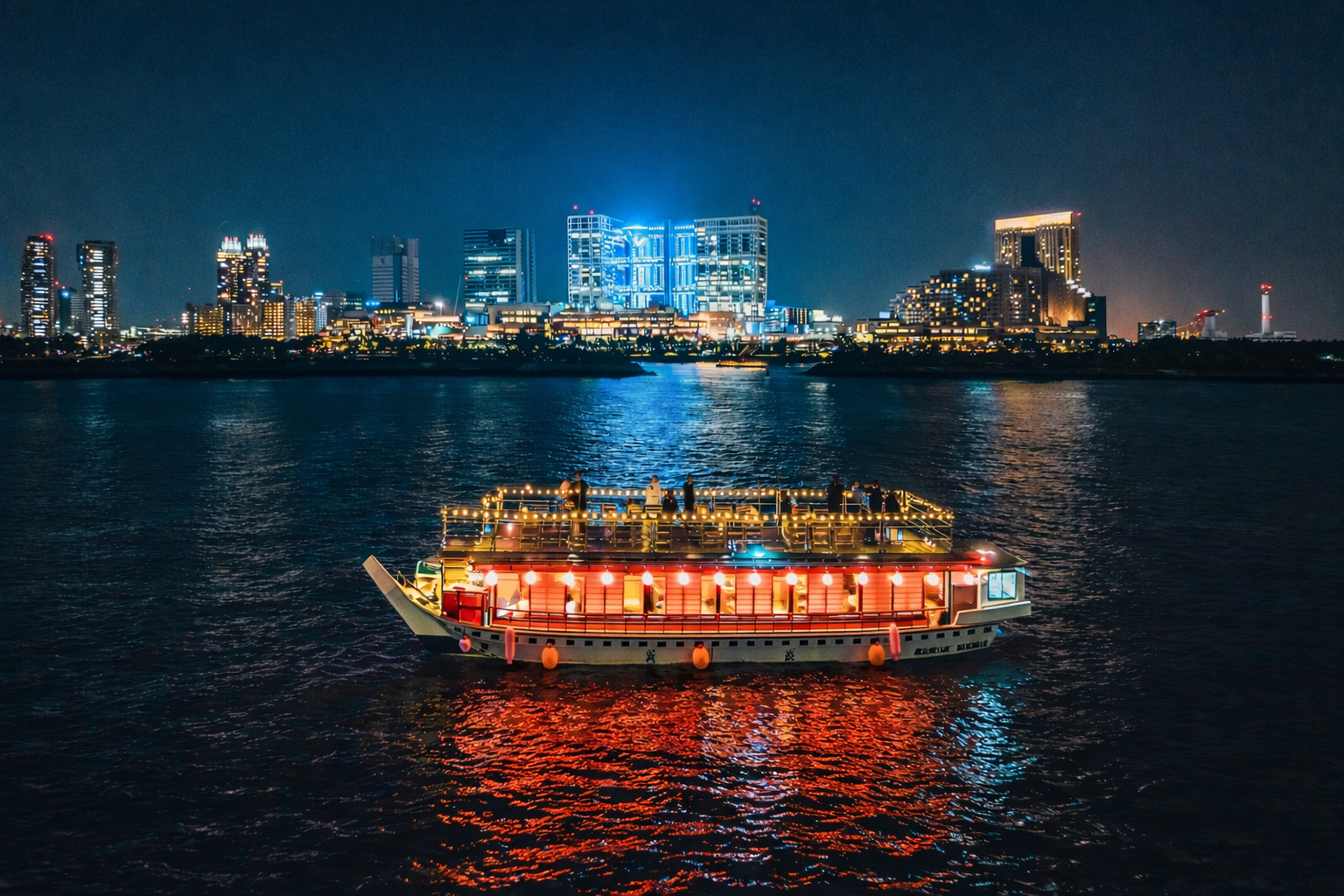
1 hr 30 min
Tokyo Yakatabune Cruise: Edo-Era Dining on Tokyo Bay
Sail Tokyo Bay on a centuries-old yakatabune houseboat with sukiyaki dining and live shamisen music.
Reserve
Hand-picked by our editors — only the best 5 cruises from 40 reviewed.
Verified partners for every tour, free cancellation where available, and instant confirmation on every booking.
1 hr 30 min
Sail Tokyo Bay on a centuries-old yakatabune houseboat with sukiyaki dining and live shamisen music.
Reserve
2 hr 30 min
Glide through Tokyo's illuminated waterways aboard a classic dinner boat with a 14-course Japanese feast.
Reserve
1 hr 30 min
Drift through Tokyo Bay on a historic houseboat with live music, hot pot dining, and skyline views.
ReservePrices from verified partners. Availability updates in real time at checkout. Free cancellation policies apply where shown.
The landmarks, rooms, and views travelers on this tour remember — all visible on a single visit.
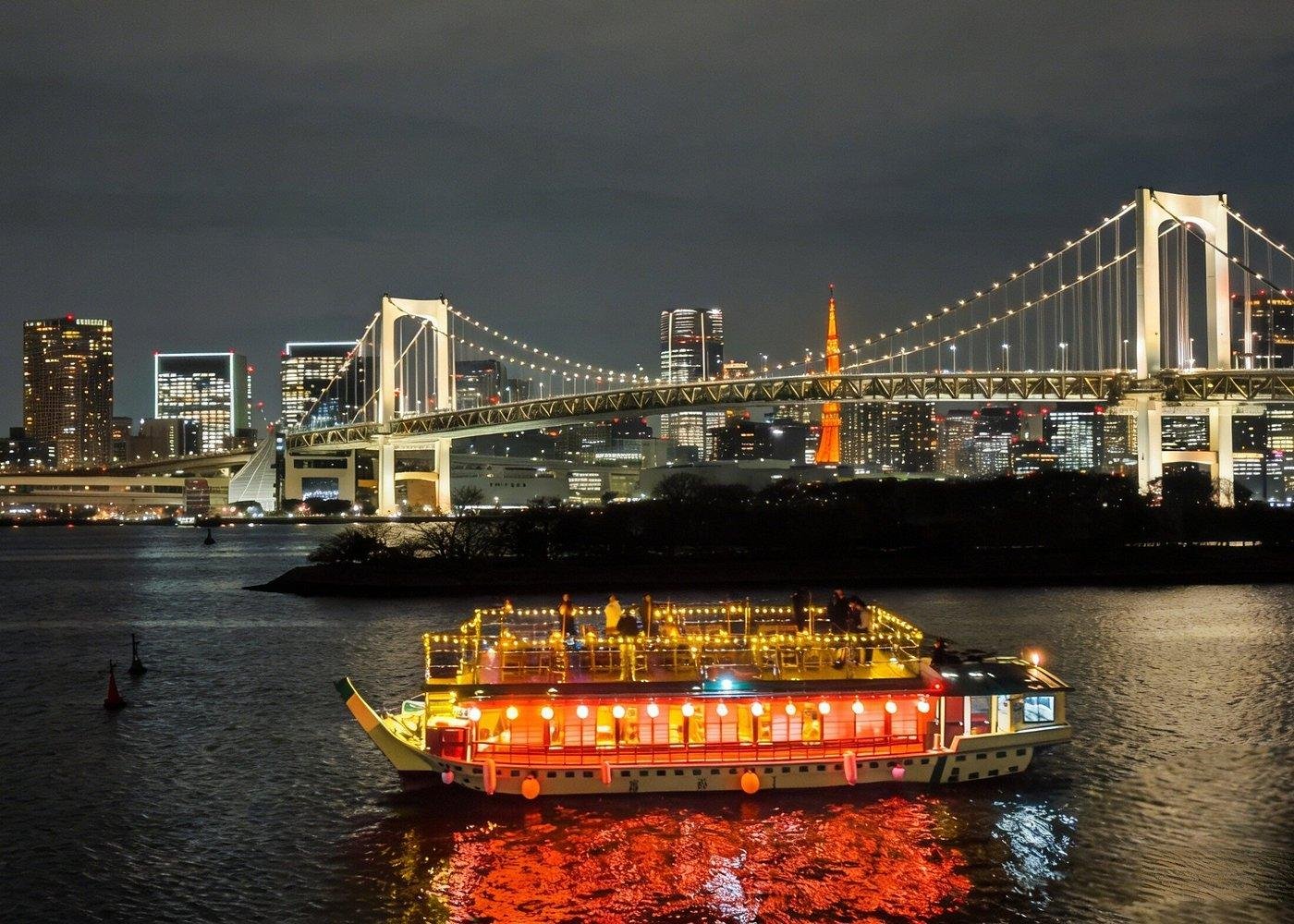
A 798-meter suspension bridge connecting Tokyo to Odaiba that glows with signature illumination at night.
Standing at 634 meters, this broadcasting tower is a dominant landmark viewed from the Sumida River.
A futuristic artificial island district featuring diverse modern architecture and shopping centers.
Known for its unique golden flame sculpture, this building is a distinct landmark along the Sumida River.
The river is crossed by multiple historic and architecturally unique bridges illuminated after sunset.
These experiences serve different needs; travelers seeking heritage and authentic cuisine choose the traditional vessel, while those prioritizing amenities and wide-angle views prefer modern ships. The yakatabune dinner cruise tokyo bay provides an intimate cultural encounter, whereas large-scale sightseeing vessels prioritize expansive observation decks.
| Feature | Top pick Yakatabune | Modern Cruise |
|---|---|---|
Boat Style |
Traditional wooden vessel | Large steel ship |
Atmosphere |
Intimate and historical | Contemporary and social |
Seating/Dining Style |
Floor seating with set meal | Table seating with buffet/a la carte |
Stability |
Sensitive to water movement | Highly stable with stabilizers |
Viewing Decks |
Low-level windows | Open-air top decks |
Price Category |
From 12,000 JPY (summer) | Varies by operator and package |
| See tickets → |
Verdict: If you want to secure your yakatabune dinner cruise tokyo bay tickets, book for the evening to catch the sunset, whereas choosing the modern cruise is better for panoramic photography and architectural sightseeing.
Choose your ticket, select your date, and reserve in under two minutes. Secure checkout handled by our verified partner.
Instant confirmation by email, with a mobile voucher you can save offline. No printing, no queuing at a collection desk.
Arrive at the entrance, show your voucher on your phone, and walk in. Most tickets include priority or skip-the-line access.
Practical details for your visit straight from our verified partners — hours, access, rules, and how to get there.
Smart casual is recommended for your yakatabune dinner cruise tokyo bay. Please be prepared to remove your shoes before entering the cabin to enjoy the tatami flooring.
Luggage storage is not available at the piers. Ensure you carry only essential items as space on board is limited during your yakatabune dinner cruise tokyo bay experience.
Photography is highly encouraged during your yakatabune dinner cruise tokyo bay. Capture the illuminated bridges and skyline, but please respect the privacy of other passengers.
Most vessels are equipped with restrooms, though boarding access can vary due to tidal changes at the piers. Please verify accessibility with your chosen operator when booking your yakatabune dinner cruise tokyo bay.
Children are welcome on board, though age-specific policies and pricing may apply. Contact your operator to confirm suitability for your family before booking your yakatabune dinner cruise tokyo bay.
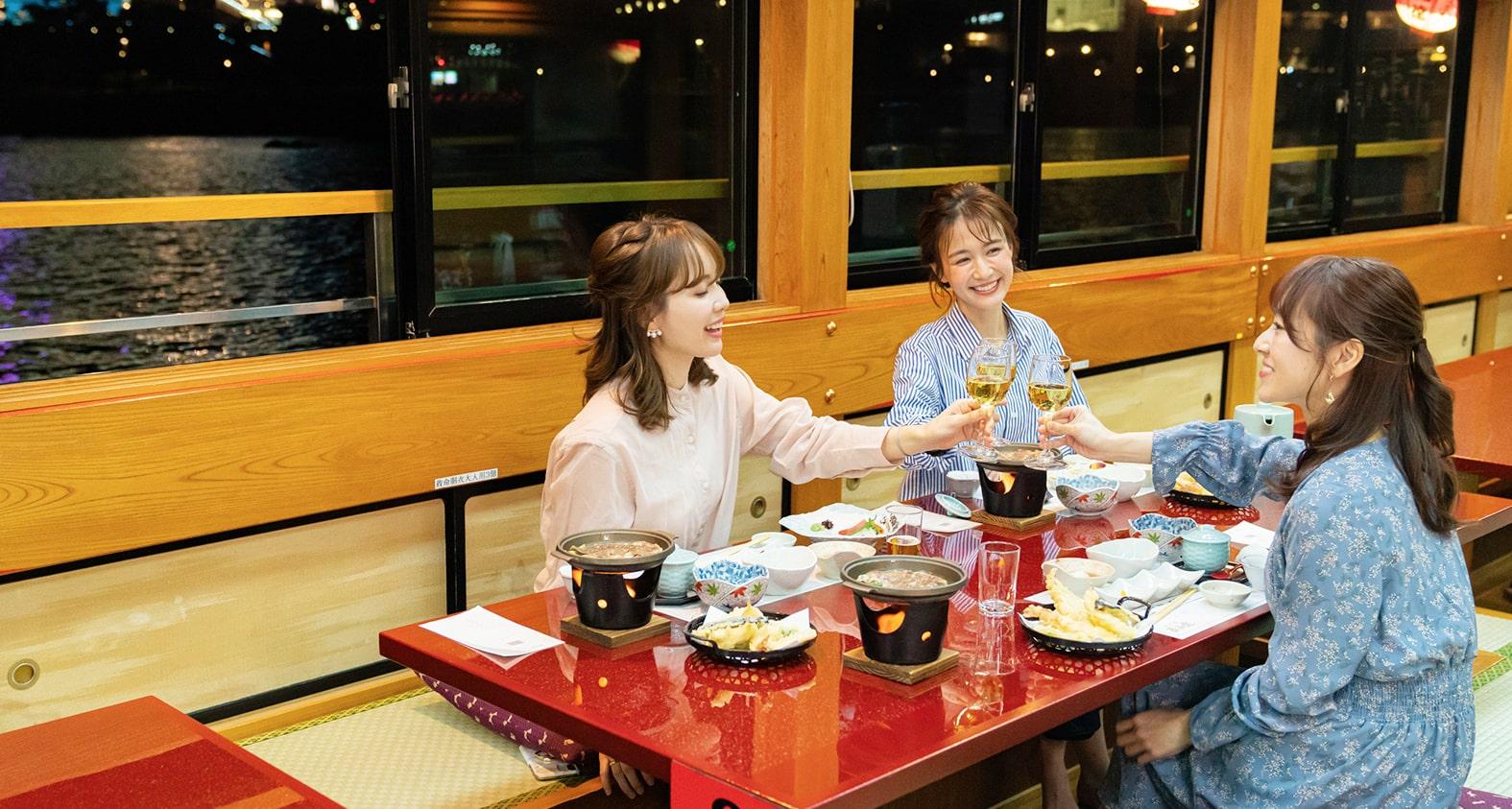
A traditional meal including tempura and sashimi is served alongside an all-you-can-drink package. Dietary restrictions should be communicated during the reservation of your yakatabune dinner cruise tokyo bay.
Best time to go, insider tips, nearby landmarks, and the cancellation fine print — flip through to skim what matters to you.
Flexible, no hidden fees.
Cancellations on short notice will not get any refunds. Guests must follow operator-specific terms which often scale based on the notice period provided.
Edo's pleasure boats were once regulated by decree: in 1649 the shogunate capped the size and ornamentation of private craft, and the merchant class answered by making their low, roofed boats beautiful instead of large. That constraint produced the yakatabune — literally "mansion boat" — a flat-bottomed vessel with tatami flooring, sliding shoji panels, and rows of paper lanterns strung along the eaves. By the Genroku era, hundreds of them worked the Sumida River. Daimyo families kept private craft. Merchants hired boats by the evening. The vessels drifted downstream to watch fireworks, moon-viewing parties, and the cherry blossoms at Mukojima. Ukiyo-e artists recorded them constantly. Hiroshige placed them beneath Ryogoku Bridge; Hokusai set them against the same water. The Sumida was then Tokyo's principal thoroughfare, and the boats were both transport and theatre. The tradition nearly ended twice. The Great Kanto Earthquake of 1923 destroyed most of the fleet and the riverside teahouses that supplied it. Post-war industrial discharge then turned the lower Sumida anoxic; by the 1960s the river carried little life and few boats. Restoration came slowly. Water-quality legislation in the 1970s, the removal of riverside industry, and the reconstruction of the embankments returned the channel to usable condition. Operators rebuilt hulls in steel, added glazed windows and air conditioning, and extended routes past the Sumida's mouth into Tokyo Bay proper. A yakatabune dinner cruise tokyo bay itinerary today typically threads beneath a dozen bridges before opening onto the bay at Odaiba. The geography explains the appeal. The Sumida runs roughly 27 kilometres from the Arakawa to the harbour, crossed by bridges of deliberately varied engineering — Kiyosu's suspension curve, Eitai's steel arch, the vermilion trusses of Azumabashi. From the water the skyline arrives in sequence: Tokyo Skytree at 634 metres, the Asahi Beer Hall, then Tokyo Tower and the Rainbow Bridge as the boat clears Hamarikyu. Tokyo houseboat dinner cruise tours are, in effect, a moving elevation survey of the city. The cuisine is equally fixed by history. Edomae tempura was river-and-bay food, fried in sesame oil and eaten fresh from the fryer; that dish remains the standard course aboard, often served alongside sashimi and, on some vessels, a sukiyaki pot. Shamisen players and, occasionally, geisha entertainment survive on certain charters. Roughly forty operators belong to the Tokyo Yakatabune Association, which maintains safety standards and publishes boarding information at yakatabune-kumiai.jp; its office answers on +81-3-5825-5526. The boats matter now for a reason beyond nostalgia. Tokyo has largely turned its back on its waterways — expressways cover several canals, and the riverbanks are walled in concrete. Aboard a yakatabune the original orientation is restored. The city is seen from below and from the centre of the channel, as it was designed to be seen when Edo was a water city of canals rather than a rail metropolis. Passengers on 屋形船 東京湾 evening sailings, whatever else they book, are borrowing a four-century-old vantage point.
"Aboard a yakatabune the city is seen from below and from the centre of the channel, as Edo was designed to be seen."
A step-by-step walkthrough of the visit — what you'll see, how long each stage takes, and the details that matter.
You reach the pier between 17:00 and 18:30, when the boats are still tied up and the lanterns are being switched on along the eaves. Boarding locations vary by operator, so you check your voucher twice before walking the gangway. Shoes come off at the threshold. You step onto tatami and pick a place at the low table, and if the boat has an open upper deck you note the stairway for later. The engine turns over. The pier slides back. Tempura arrives in waves rather than all at once — shrimp first, then kisu, then vegetables, each set down while the batter is still crackling. You pour for the person opposite you, they pour for you, and the shoreline begins to move. Bridges pass overhead in slow succession, each one lit differently, and you learn to feel the moment before Skytree appears in the gap. Around the halfway point the boat clears the river mouth and the water widens. You climb to the upper deck. The wind is warmer than expected on an August night, and the Rainbow Bridge holds its full span across the horizon while Tokyo Tower burns orange behind the Shibaura container cranes. Most yakatabune dinner cruise tokyo bay sailings pause here, engines idling, for photographs. Back below, someone tunes a shamisen. The boat turns upstream. You finish the last of the pot, watch the same bridges arrive in reverse order, and step back onto the pier with the lanterns still burning behind you.
The association office is open 10:00–17:00, Monday through Saturday.
Accessibility varies by vessel, so please confirm specific boat facilities when booking your yakatabune dinner cruise tokyo bay.
The recommended arrival window is 17:00–18:30 to catch the sunset and evening city views.
Outside food and drinks are generally not permitted as meals and beverages are included in your yakatabune dinner cruise tokyo bay.
Prices start from 12,000 JPY per person including meal and drinks.
Children are welcome, but policies vary by operator; please confirm requirements for your yakatabune dinner cruise tokyo bay.
No, piers do not provide parking; please use public transport or nearby coin parking for your yakatabune dinner cruise tokyo bay.
Cruises typically last 2–2.5 hours, allowing ample time for sightseeing.
Yes, cancellation fees apply and vary by operator; please check your specific yakatabune dinner cruise tokyo bay terms.